Climatic and Environmental History of the Balkans during the Last Glacial and the Holocene
Introduction
The Collaborative Research Centre (CRC) 806: "Our Way to Europe - Culture-Environment Interaction and Human Mobility in the Late Quaternary" is designed to capture the complex nature of chronology, regional structure, climatic, environmental and socio-cultural contexts of major intercontinental and transcontinental events of dispersal of Modern Man from Africa to Western Eurasia, and particularly to Europe.
After leaving the Near East, some groups of Homo sapiens sapiens first arrived about 30-32 ka BP ago in the Balkans, as it is proven by human remains found in Romania. However, until now, due to the limitations of the anthropological data, only a patchy reconstruction of the routes into Europe was possible. The environmental context, which enabled the first groups of Homo sapiens sapiens to enter Europe, is still widely unknown and the detailed framework of climatic and environmental conditions requires extensive research.
The overall objective of project B2 is to reconstruct the environmental history of the Balkan region during the last Glacial-Interglacial cycle on a sub-millennial time scale. For this purpose, long sediment records from the transboundary lakes Prespa (MK/AL/GR) and Dojran (MK/GR) are / will be recovered and investigated using a multidisciplinary approach. Both lakes are located in the main tree refugial areas of important central European forest species during the glacial. The results, in concert with those from other lake projects of the CRC, promise to add fundamentally to the understanding of the environmental conditions along the eastern pathway of human migration from Africa to Central Europe.


Methods
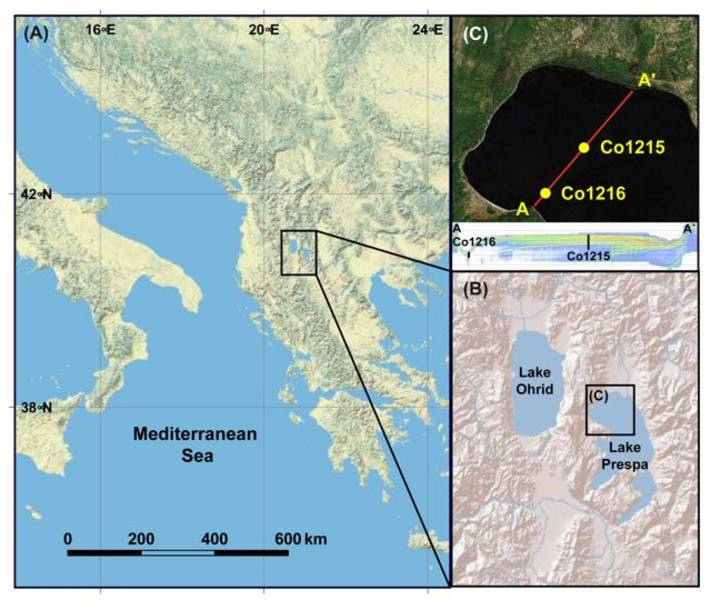
During the first field campaign in autumn 2009, two sediment cores, Co1215 (15,75 m) and Co1216 (5,75 m), were recovered from the Macedonian part of Lake Prespa (Figure 1). Coring was carried out from a floating platform, using a short gravity corer and a 3 m long percussion piston corer (UWITEC Co.). Core Co1215 was retrieved in the northern part of the lake, where the shallow seismic survey indicated a water depth of 14,5 m and a widely undisturbed sediment succession with slightly inclined bedding and parallel reflectors. Core Co1216 from the northwestern part was recovered, where the seismic survey indicated a water depth of 32 m and a channel structure.
Both cores are at present studied with a multi-disciplinary approach. Plant microfossil analyses and sedimentological and other micropalaeontological investigations on a sub-millennial scale in sediment sequences from these lakes will offer the opportunity to reconstruct even short time climate changes. Furthermore, pollen and ostracods offer the possibility to develop transfer functions in order to reconstruct quantitative changes in regional climate and hydrological conditions of the lakes. The chronology of the records is based on radiocarbon dating and tephrostratigraphy.